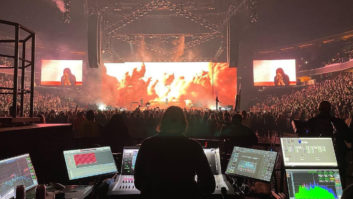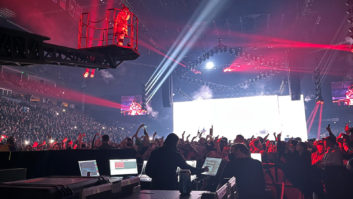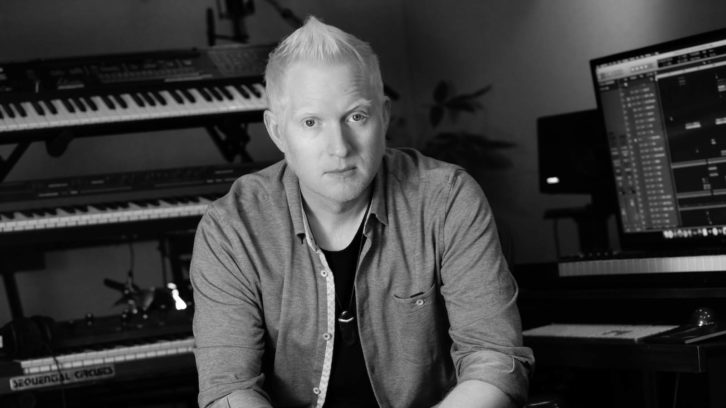
Over the past 20 years, the role of a music director has evolved from onstage conductor to behind-the-scenes programmer. Aron Forbes is comfortable in either position.
For the last decade-plus, Forbes has skillfully music-directed a number of artists, from Olivia Rodrigo and BANKS to Conan Gray, Harry Hudson and, most notably, Billie Eilish. His work for Eilish extended to her recent documentary, Billie Eilish: The World’s A Little Blurry (Apple TV+), for which he received two Emmy nominations, in the categories for Outstanding Music Direction and Outstanding Sound Mixing for a Nonfiction or Reality Program (Single or Multi-Camera).
Forbes’ relationship with Eilish and her musical partner and brother, FINNEAS, extends back to the siblings’ early days recording at their parents’ home. At the time, Forbes’ wife was taking aerial silks and lyra lessons from the young artists’ mother. A friendship developed, and later Forbes met FINNEAS at a show featuring the latter’s then-rock band.
At the same time, FINNEAS was working on music with Eilish. The two did some writing sessions with Forbes, out of which came “Bored”—to date the only released song that features an outside collaborator with the siblings. When time came for the two’s first live shows, Forbes was on hand to assist in taking the bedroom recordings to the stage.
SETTING THE STAGE
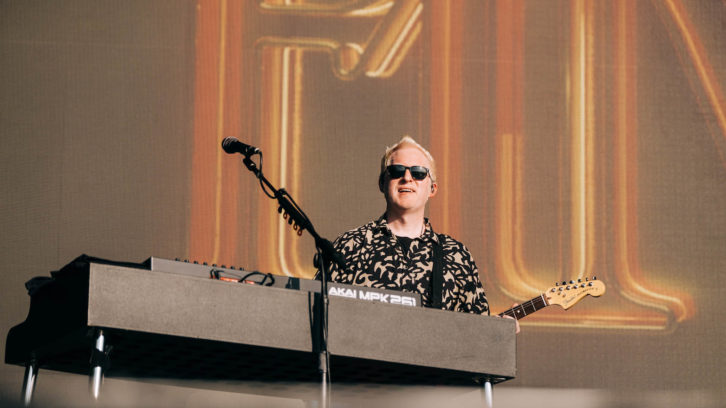
“The first thing I remember is being in their garage with an old P.A. mixer they had,” says Forbes from his studio in Los Angeles. “Back then, it was just the two of them on stage. FINNEAS and I are both Logic users. I set them up with Ableton and created a playback session, providing an infrastructure for them to build upon.”
Forbes started in Ableton Live’s Arrangement View, the most similar to Logic’s interface. Once their drummer, Andrew Marshall, was added to the live performance, Forbes switched to Clip View, only going back to Arrangement View to make edits.
“If [Marshall] has the opportunity to play something, he will play it,” says Forbes. “We have it set up where all his pads are excessively deep drum racks. They’re going on the timeline in Ableton, and all his sounds come out of the playback computer. There are songs where you can see the chain jumping around on every beat, because every time he hits it, it’s a different sound, which is really wild. The programming side of it is deep. [Marshall] is so meticulous.
He’ll chop up samples and say which ones he will play. I’ll go through my session and replace every one of them with versions that I mixed for live. So much of our rehearsal time is programming. There are days where you have six hours of programming, and you walk out of the rehearsal and your brain is absolutely destroyed.”
In addition to the sonic component, Forbes also pays particular attention to what the performance looks like, and what is the most fun for FINNEAS to play at any point in time. The shifts between performed sounds and playback sounds happen seamlessly, creating a smooth experience for the audience.
MIXING TO PICTURE
For The World’s A Little Blurry, director R.J. Cutler and the team of filmmakers tapped into Forbes’ longstanding relationship with Eilish, as well as his extensive experience, to provide the best version of songs and best quality of sound to best match Eilish’s overall aesthetic for the documentary.
“There are few roles that are as important as being the director of a documentary,” says Forbes. “For [Cutler] to be selfless enough and put ego aside to bring me in to help with the music, because he knows it’s going to serve the artist well, was really cool. I can’t overstate how cool it was to have conversations with a director who was valuing my input because he knew that I was speaking from a place that would reflect [Eilish]’s perspective. I’ve worked with them for so long, I know their music on a really intimate level. I can look at the whole musical experience of the documentary and reflect all the things about what [Eilish] likes.”
Finneas on Fire
These conversations with Cutler helped Forbes understand the storyline and help in the decision-making process for sound sources, going from performance to album recording to making everything work together. This was not dissimilar to what he does for the live shows in choosing between playing or backing tracks. Working on a film in this capacity, however, was a first for Forbes.
“Being around their family for so long, it’s years of tons and tons of data based on taste and what’s important to them,” Forbes explains. “I now have this huge file cabinet of information. It only makes sense that in going into a documentary, something so music-focused, that I be there and be an advocate for all of this information that I hold for [Eilish].”
SELECTING THE SOURCES
The World’s A Little Blurry includes footage from Eilish’s mother’s iPhone over many years, a GoPro that was permanently set up in FINNEAS’ bedroom while they were recording, as well as the cinema verite-style filming that Cutler and his team captured over the course of a year while accompanying Eilish in every aspect of her life. The audio from numerous live performances, which includes the sounds of Eilish’s famously loud choral audiences, the mono recordings from the casual footage, and the professionally captured audio from the production all had to be reconciled by Forbes in post.
“One of the unique things was how difficult it was to go back to archived years of recordings and track down performances [Cutler] wanted to use,” says Forbes. “All our live shows are recorded off of the consoles into Logic, but we’re taking source material that is completely uncontrolled. We started with only nine multitracks in the beginning. I pulled in our monitor tech and our front-of-house engineer and went through our hard drives to see if we could find more multitracks of these performances so I would have ammunition to make the film sound incredible.”
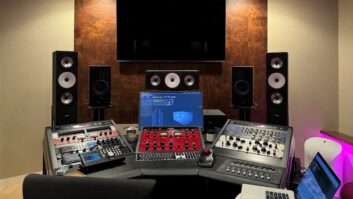
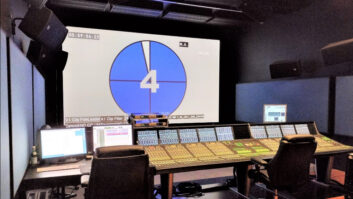
Forbes spent two months mixing the music in Logic at his home studio prior to heading to the dub stage, where he worked with Elmo Ponsdomenech, Jason Gaya and Jae Kim.
“It was a staggering amount of work to get the audio to play down like a story in the same way of the storyline you’re seeing,” Forbes says. “What I would consider one of the greatest voices ever, singing like she does, softly into a microphone, in an arena with 20,000 kids screaming louder than she is, I have to get that vocal to be out in front and sound like a recording. I did automation and Audio Suite processing in Logic, making chains so I could take out bottom end. Piece-by-piece I took the crowd noise out of her vocal mic, then the drums out. I had to figure out how to carve her voice out, and our sound team had to figure out how to put some of the audience back in.”
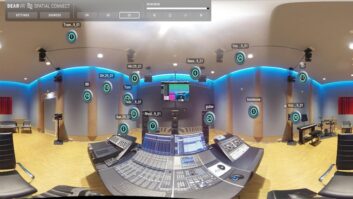
Getting the mono sounds on the same level as the rest of the film was a completely different challenge. The sounds are augmented with rooms and space, making use of the Dolby Atmos immersive format to boost them from their mono state and have them sit next to a 60-track audio segment without any sonic dips.
Says Forbes: “Being a music director to an artist, and going over these years of growth, then the world shutting down, and then being brought in to work on a documentary that revisits all of the years as a music director of that work, is really heavy and super-cool and real. I have to pinch myself because it doesn’t get much better than that.”